


In this article
There is no single best chord progression. Start with a short pattern such as C–G–Am–F or Am–F–C–G, then judge it against your melody and groove. Familiar chords can support very different songs when their timing, bass and voicings change.
Hear the examples.
Choose an example, then press Play. Compare the notes as well as the sound.
C–G–Am–F
Compare this ordering with C–Am–F–G. The return to the first chord changes.
These are not Captain Plugins audio.Ready to play
Choose a starting point for the phrase
If you want a major-key loop that moves away from home and circles back, try C–G–Am–F. If you want a more direct setup for returning to C, try C–Am–F–G. Play both with one chord per bar and the same sound before choosing.
The table is a writing reference, not an accuracy ranking or a claim about which pattern is used most. A progression earns its place by supporting your song. You can use only two chords if the melody and arrangement keep the phrase moving.
Try a minor starting point
Am–F–C–G uses i–VI–III–VII in A minor, while Am–C–G–F uses i–III–VII–VI. These share the same chord collection but place the changes in a different order. Listen to which chord lands beneath the strongest part of your melody.
Roman numerals here are relative to the named major or minor key. Some resources use major-scale-referenced notation and write ♭VI, ♭III and ♭VII for those minor-key chords. The actual A-minor chords are still F, C and G.
Change the voicing before replacing the pattern
A progression can feel repetitive because every chord is played in the same block shape. Keep common tones, move one voice at a time, or put a different chord tone on top. The top note can act like a small melody of its own.
Try C–E–G followed by C–E–A for the C-to-Am change. Then continue with C–F–A and B–D–G for F and G. These are playable voicing ideas, not the only correct arrangement. Check how the low notes interact with your bass.
Develop contrast across the song
Once the loop supports a melody, make a second section by changing the harmonic rhythm, starting on another chord, or holding one chord longer. You do not need a new chord on every beat or a completely unrelated chorus.
Keep an untouched version so you can compare edits. Add sevenths, suspended notes or substitutions one at a time. If the new chord distracts from the hook, the simpler version may be doing its job better. Listen at the intended tempo with the vocal or lead in place.
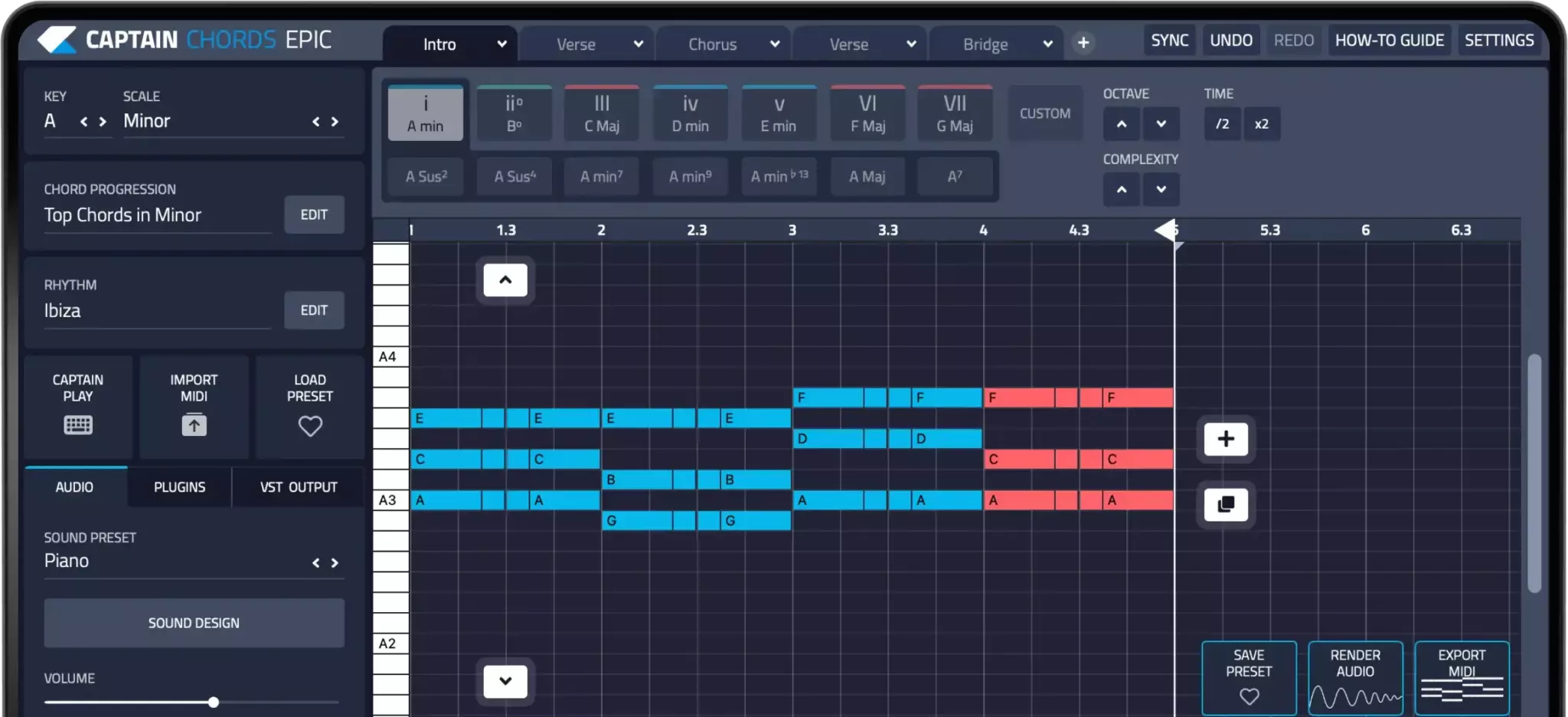
Keep the notes in view.
| Pattern | Example | Try it when |
|---|---|---|
| I–V–vi–IV | C–G–Am–F | You want a repeating major-key loop |
| I–vi–IV–V | C–Am–F–G | You want a setup for returning to I |
| I–IV–vi–V | C–F–Am–G | You want to compare a different middle pair |
| i–VI–III–VII | Am–F–C–G | You are shaping a minor-centred loop |
| i–III–VII–VI | Am–C–G–F | You want another minor-key ordering |
| ii7–V7–Imaj7 | Dm7–G7–Cmaj7 | You want to explore seventh-chord movement |
Try it in Captain Chords.
Create two short versions from the table and audition them with the same melody. Save the one that fits, then use Captain Chords to refine rhythm and voicing before exporting your part.
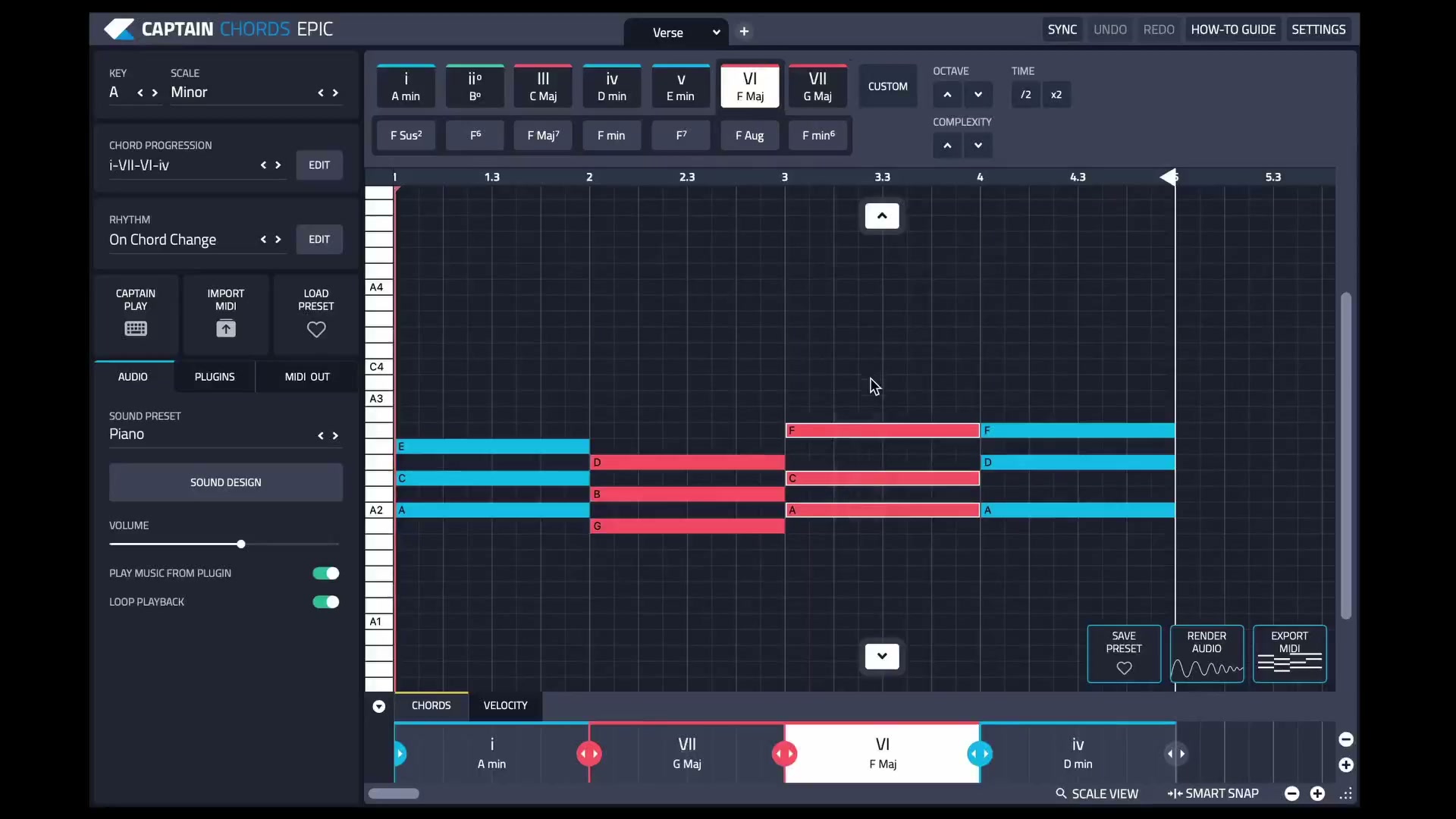
See the current editing workflow.
The Captain Plugins 8 update video shows the canvas and selection-based editing.
Common questions
What is the best progression for beginners?
C–Am–F–G is a practical starting point because its triads use notes from C major. Learn the notes and changes, then try it in another key.
Will a familiar progression make my song sound copied?
The chords are only one part of a song. Write your own melody, rhythm, arrangement and production rather than copying an existing recording or distinctive musical material.
Does I6 mean a tonic chord with an added sixth?
In conventional Roman-numeral analysis, a superscript 6 usually indicates first inversion. A chord symbol such as C6 means C–E–G–A. State your notation clearly.
Lesson and examples updated by Mixed In Key.