


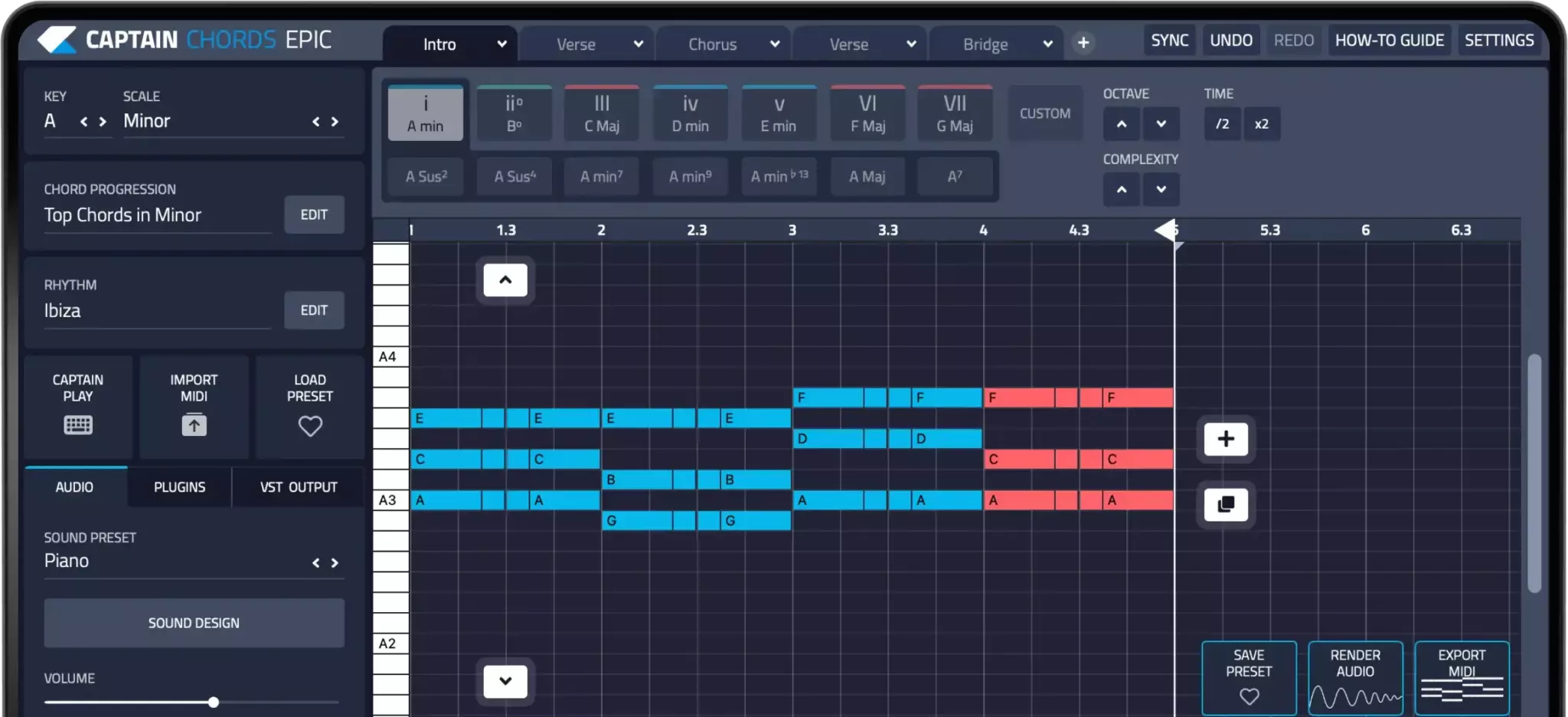
In this article
A chord progression is a sequence of harmonies over time. It works through the relationship between the chords, the tonal centre, the melody and the timing of each change. A progression does not have to start or end on the tonic to be usable.
Hear the examples.
Choose an example, then press Play. Compare the notes as well as the sound.
C–Am–F–G
One chord per beat in this short demonstration. Use longer durations when writing your song.
These are not Captain Plugins audio.Ready to play
Choose a tonal centre, then map the chords
In C major, the diatonic triads are C, Dm, Em, F, G, Am and Bdim. They are built by stacking alternate scale notes above each degree. Roman numerals show their position: I, ii, iii, IV, V, vi and vii°. Uppercase means major, lowercase minor, and ° means diminished.
Diatonic means drawn from the scale, not automatically good in every combination. A key gives you a useful starting set. You can later borrow or alter chords, but first learn to hear what a simple sequence does with one melody.
Listen for rest, movement and return
The tonic often feels like home. Predominant chords can prepare movement toward a dominant, and a dominant can create a pull back to tonic. In C major, Dm–G–C is a clear example of that route. These roles help explain common patterns without turning them into laws.
Many loop-based tracks delay or soften the feeling of arrival. C–G–Am–F ends on F and returns to C when the loop repeats. The melody, bass and accents help determine the tonal centre; the first chord alone does not prove the key.
Connect the notes between the chords
Voice leading is the movement of individual notes from one chord to the next. C–E–G moving to C–E–A retains two notes and moves one. That can sound smoother than jumping every chord to a new root-position shape in another register.
Smooth movement is one option, not a requirement. A large jump may be exactly what a hook needs. Compare a connected version with a deliberately wider version, keeping the sound and rhythm the same so you can hear the difference.
Give the harmony a rhythm and a destination
Harmonic rhythm means how often the chords change. One chord every two bars creates a different pace from two chords per bar, even at the same tempo. Try holding a chord through a fill or changing just before the downbeat to see how timing affects the phrase.
Listen across the loop boundary as well as within it. If the last chord never feels connected to the first, revise that transition, add a turnaround or stop treating the passage as a loop. A verse and chorus can share chords while changing register, rhythm or bass movement.
Keep the notes in view.
| Degree in C major | Chord | Notes |
|---|---|---|
| I | C | C · E · G |
| ii | Dm | D · F · A |
| iii | Em | E · G · B |
| IV | F | F · A · C |
| V | G | G · B · D |
| vi | Am | A · C · E |
| vii° | Bdim | B · D · F |
Try it in Captain Chords.
Write C–G–Am–F with one chord per bar, then make a second version with the same harmony and different inversions. Finally change only the rhythm and compare all three.
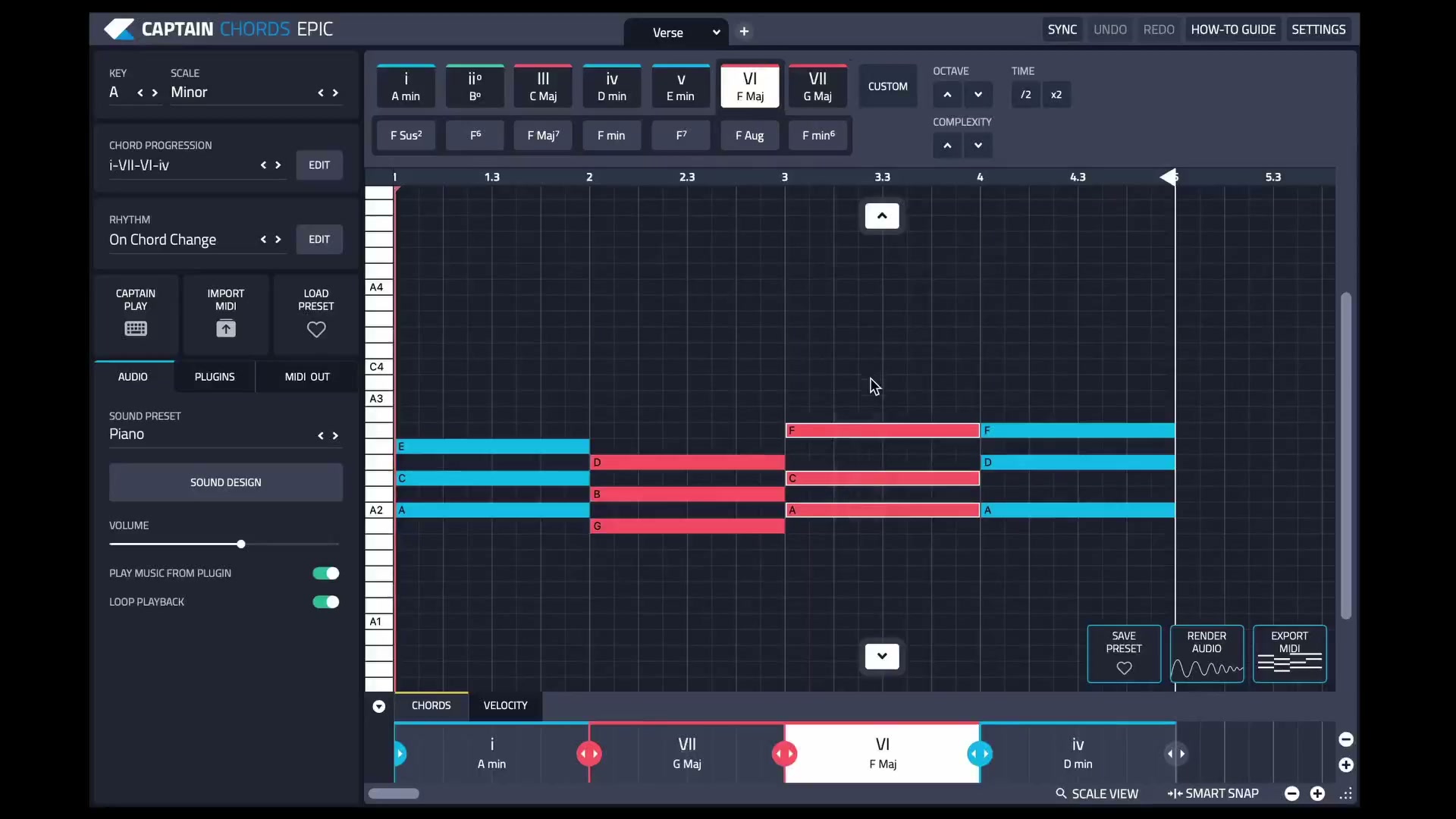
See the current editing workflow.
The Captain Plugins 8 update video shows the canvas and selection-based editing.
Common questions
Must a progression start on the tonic?
No. Starting elsewhere can create movement or ambiguity. Use the full phrase, melody and bass to establish the tonal centre.
What makes two progressions sound different if their chords match?
Voicing, register, bass movement, rhythm, melody, sound and arrangement can all change the result.
What do Roman numerals tell me?
They show a chord’s scale-degree position relative to the key. This makes it easier to move a pattern to another key without memorizing only letter names.