


In this article
A minor chord progression centres on a minor tonic, but it can contain both major and minor chords. In A natural minor, the diatonic triads are Am, Bdim, C, Dm, Em, F and G. Raising G to G♯ allows E major or E7 to lead more strongly back to Am.
Hear the examples.
Choose an example, then press Play. Compare the notes as well as the sound.
Am–F–C–G
A minor-centred four-chord starting point. The melody and phrasing help establish the key.
These are not Captain Plugins audio.Ready to play
Begin with the natural minor scale
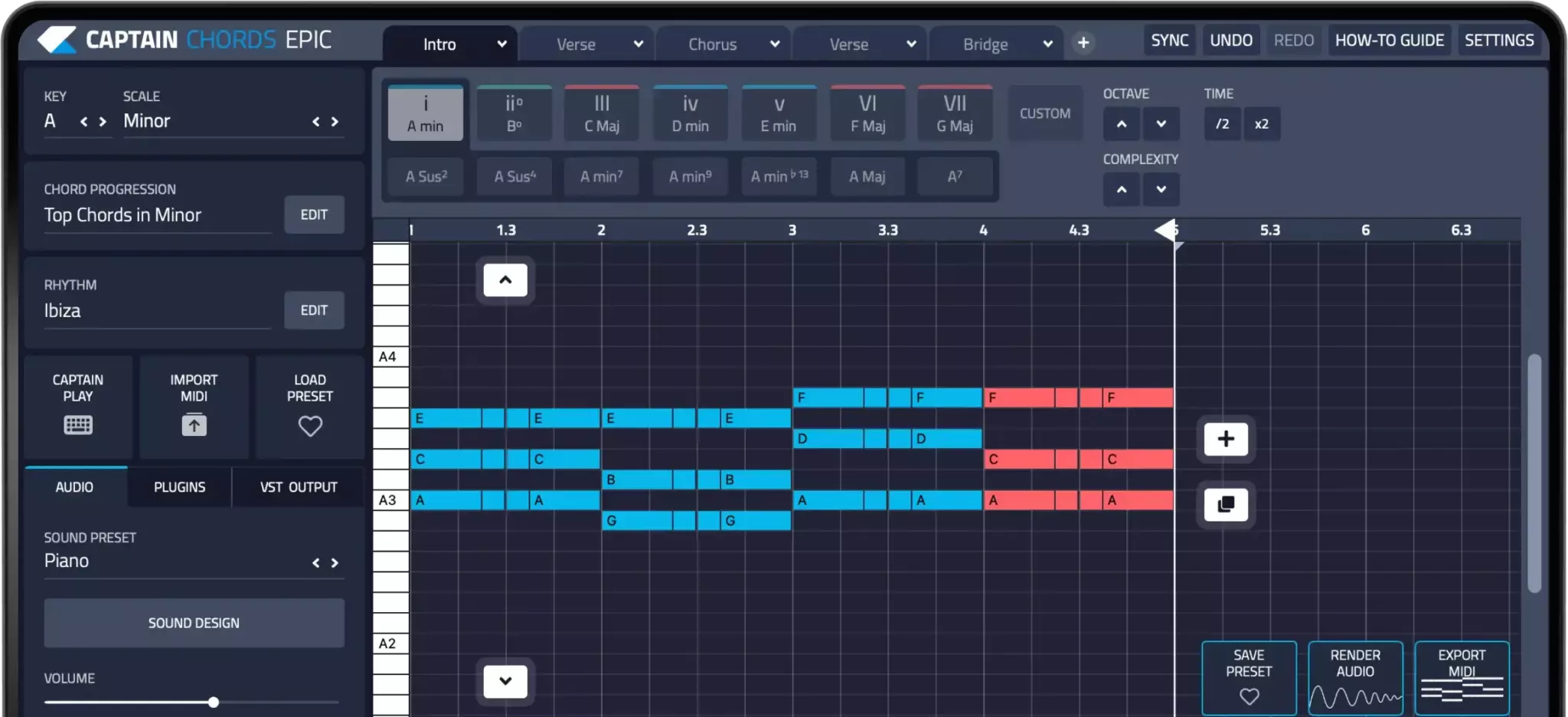
A natural minor contains A–B–C–D–E–F–G. Build a triad on each note by taking alternate scale notes. The pattern is minor, diminished, major, minor, minor, major, major. The table gives both the symbols and actual notes so you can check your piano roll.
Diatonic means the chord tones come from that scale. It does not mean every possible ordering will suit a vocal or feel resolved. Start with a small group of chords and listen for A as the tonal centre.
Compare two four-chord loops
Play Am–F–C–G, then Am–C–G–F. The first is i–VI–III–VII and the second i–III–VII–VI in A minor. Hold each chord for a bar and keep the sound unchanged. Notice how the different last chord changes the return to Am.
Some charts describe the same major chords as ♭VI, ♭III and ♭VII relative to a major-scale reference. Here, numerals follow the named minor key. When sharing a progression, include the key and chord letters so the notation is unambiguous.
Use E major or E7 for a stronger return
A natural minor gives you Em: E–G–B. Raising G to G♯ creates E major, and adding D gives E7. The G♯ can rise by a semitone to A, giving the return to Am a clear leading-tone movement.
This is one reason minor-key writing often mixes natural-minor material with raised-seventh harmony. You do not need to force every melodic note into one unchanging scale label. Check how G and G♯ are used at different moments and avoid an accidental clash across parts.
Shape the bass and melody together
Try Am–Dm–E7–Am for a short phrase with a strong return. Keep the bass roots simple, then adjust the upper notes so they move smoothly. A melody landing on C over Am emphasizes the minor third; landing on G♯ over E7 emphasizes the approach to A.
If the progression feels heavy, move upper chord tones out of the low register. If it feels too predictable, change when a chord arrives before adding more harmony. A rest, held note or slower change can create useful contrast without replacing the whole sequence.
Keep the notes in view.
| Degree | Chord in A natural minor | Notes |
|---|---|---|
| i | Am | A · C · E |
| ii° | Bdim | B · D · F |
| III | C | C · E · G |
| iv | Dm | D · F · A |
| v | Em | E · G · B |
| VI | F | F · A · C |
| VII | G | G · B · D |
Try it in Captain Chords.
Compare Am–F–C–G with Am–Dm–E7–Am. When adding E7, inspect the G♯ and listen against the melody. Keep a copy of the natural-minor version for comparison.
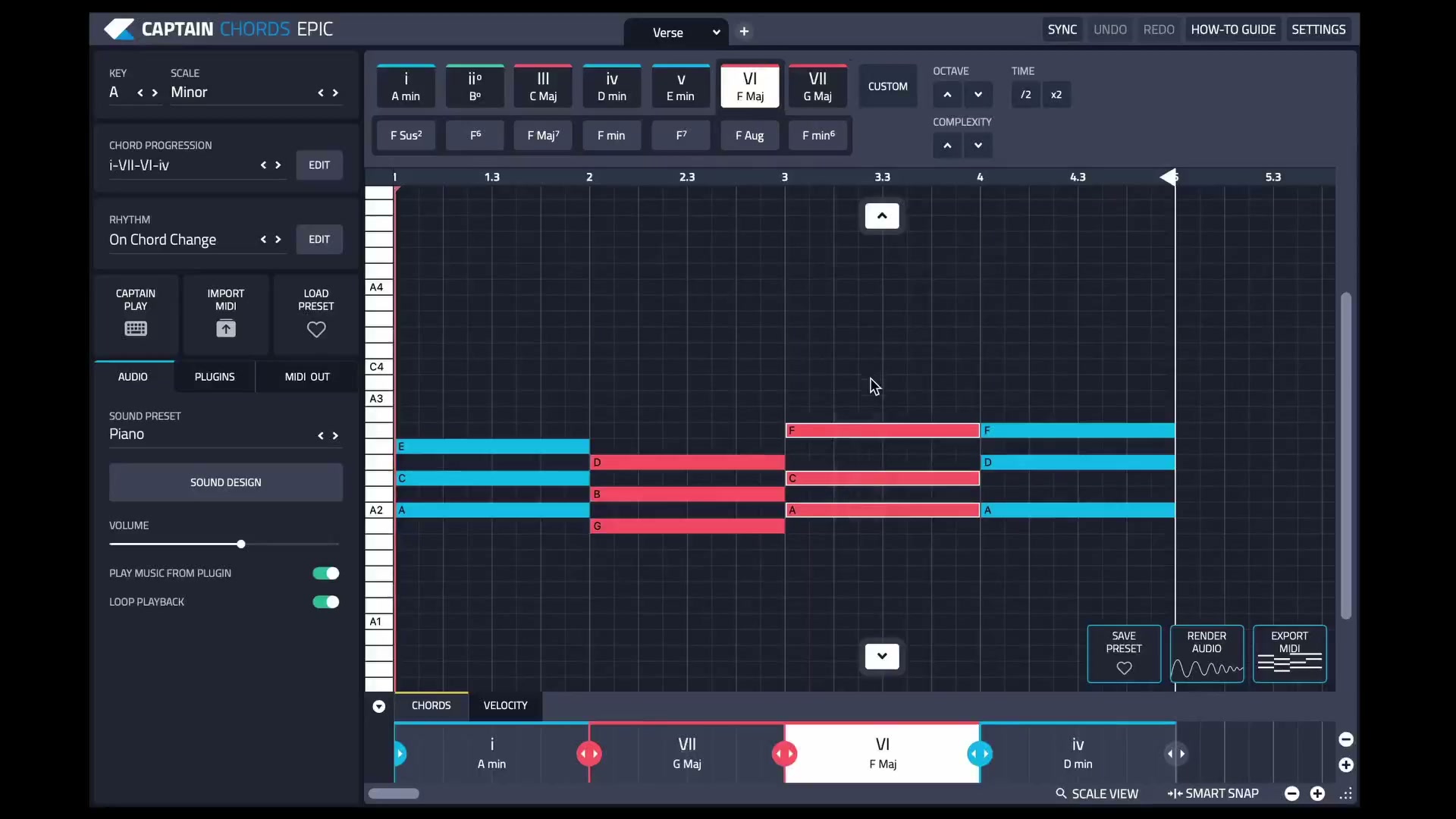
See the current editing workflow.
The Captain Plugins 8 update video shows the canvas and selection-based editing.
Common questions
Can a minor progression contain major chords?
Yes. C, F and G are all diatonic major triads in A natural minor. E major is also common when using the raised seventh, G♯.
Why use E7 instead of Em in A minor?
E7 contains G♯, which can lead into A by a semitone. Em contains G natural and gives a different, less leading-tone-driven return.
Are A minor and C major the same key?
They share the notes of their natural minor and major scales, but their tonal centres differ. Melody, bass, phrasing and harmonic emphasis help establish which note feels like home.
Lesson and examples updated by Mixed In Key.