


In this article
G natural minor contains G, A, B♭, C, D, E♭ and F. The tonic triad is G–B♭–D. Raising F to F♯ gives the harmonic-minor collection and supports D major or D7 before Gm.
Hear the tonic chord clearly
Play G–B♭–D in a comfortable middle register. Compare it with G–B–D to hear how the third determines minor or major quality. Keep the sound, velocity and note lengths the same. The comparison is about pitch relationships; a bright sound can play a minor chord and a dark sound can play a major one.
Build the natural-minor triads
Stack alternate notes of the scale to get Gm, A diminished, B♭, Cm, Dm, E♭ and F. Try Gm–E♭–B♭–F as a starting loop. Keep the chords simple while listening for the bass movement. B♭ major shares these notes, so a progression needs phrasing to make G sound like the centre.
Compare two versions of the dominant
Play Cm–Dm–Gm, then Cm–D7–Gm. D7 contains D, F♯, A and C. Its F♯ sits a semitone below G, creating a strong upward motion into the tonic. The natural-minor Dm version has a different, softer relationship. Choose between them by the phrase, rather than treating one as universally correct.
Avoid awkward melodic jumps when changing the scale
Raising F to F♯ creates a wider gap from E♭. That gap can be useful, but you do not have to feature it in every melody. Try E♭–D–F♯–G, or approach F♯ from D, and listen to the contour. Minor-key writing often adjusts notes according to the direction and harmony of the phrase.
Use inversions to control the register
For Gm–E♭–B♭, try G–B♭–D, G–B♭–E♭ and F–B♭–D above the bass roots. The common B♭ holds the parts together. Keep low voicings open if the bass is sustained, and shorten release times where chords overlap. Clear spacing makes a simple progression more useful than a crowded extended chord.
Make an ending different from the loop
A repeating four-chord pattern may work throughout a section, but the final phrase can use Cm–D7–Gm to signal an arrival. Change the melody ending as well, perhaps sustaining G after a rest. This creates structure with the existing material instead of adding an unrelated section every time you need contrast.
Hear the dominant in G minor
The same Cm chord leads to two different dominant choices. Compare Dm with D7 before the music returns to Gm.
A · Cm–Dm–Gm
Dm contains F natural, from G natural minor. Gm repeats across the final two bars.
C–E♭–G | D–F–A | G–B♭–D, repeated.
Ready to play
Original synthesized lesson examples with a simple piano-like tone. These illustrate the musical idea; they are not recordings of Captain Plugins or finished genre productions.
Try this in your project
Write eight bars in G minor. Use Gm–E♭–B♭–F for the first four, then finish with Cm–D7–Gm held for two bars. Record the melody with F natural first, then adjust the final phrase to include F♯ where D7 occurs.
Quick reference
| Focus | What to try | What to listen for |
|---|---|---|
| Natural minor | G A B♭ C D E♭ F | The basic seven-note collection |
| Harmonic return | Cm–D7–Gm | F♯ leading into G |
| Voicing | Keep B♭ across nearby chords | Connection without large jumps |
Work with Captain Chords
Use Captain Chords to sketch the harmony, edit its voicing and rhythm, then develop the arrangement in your DAW.
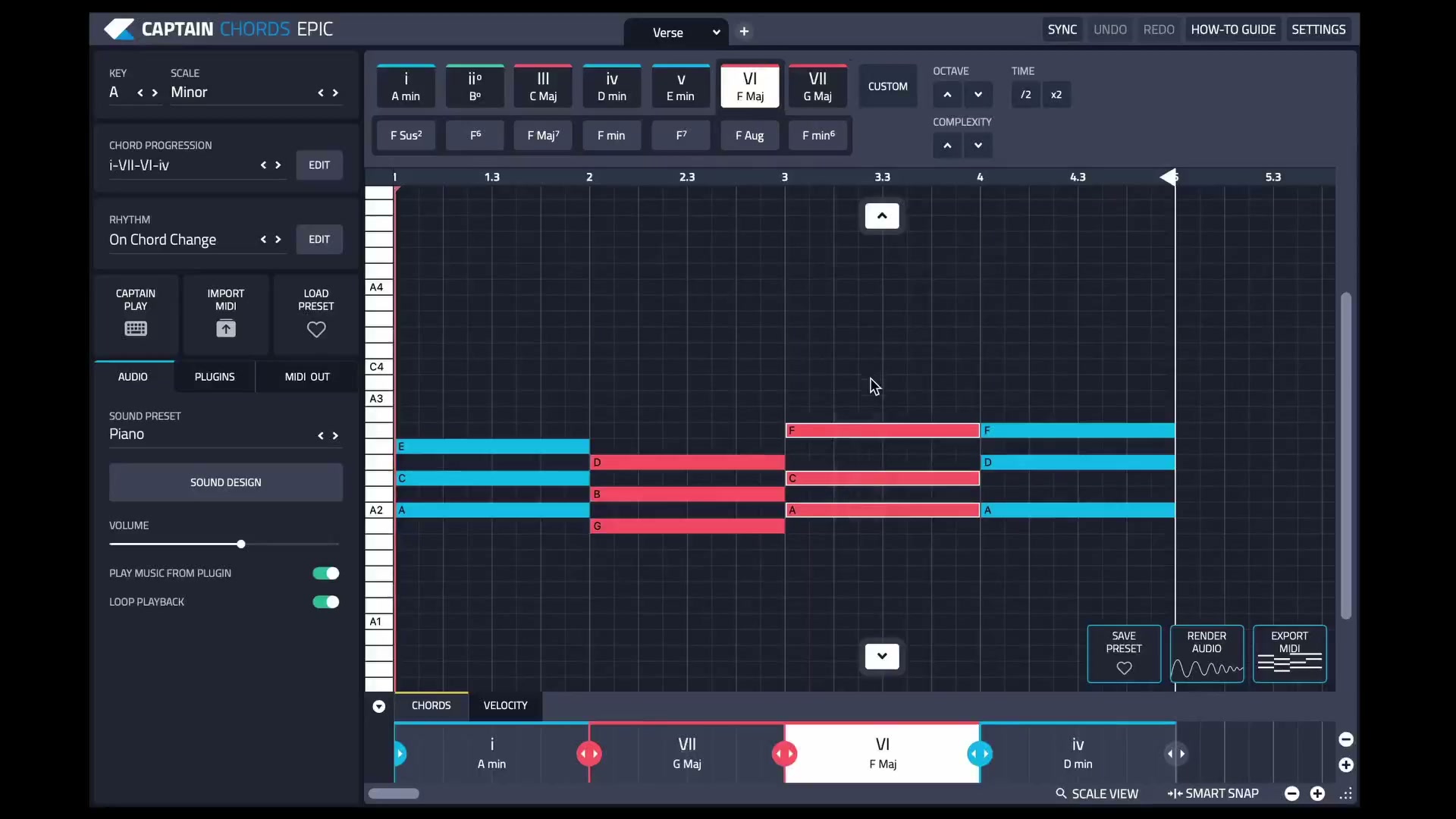
Captain Plugins 8 overview
See the update video for the current canvas and editing workflow.
Common questions
What is the relative major of G minor?
B♭ major. They share two flats but establish different tonal centres.
Does G minor always need F♯?
No. F♯ is a common harmonic choice near the dominant. Natural-minor passages can use F without a raised leading note.