


In this article
An augmented triad contains a root, major third and augmented fifth: 0, 4 and 8 semitones from the root. C augmented is C–E–G♯, written Caug or C+. It is a distinct triad quality, not just another name for major.
Hear the examples.
Choose an example, then press Play. Compare the notes as well as the sound.
C major
The major third is E. Keep C and G in place when comparing major with minor.
These are not Captain Plugins audio.Ready to play
Raise the fifth by one semitone
Begin with C–E–G and raise G to G♯. Keep C and E still. The chord now contains two stacked major thirds: C to E, then E to G♯. You can build the same shape from any root by using two four-semitone steps.
Spell the last note as G♯ rather than A♭ when naming C augmented: it is an altered fifth, so it keeps the fifth’s letter name. On an equal-tempered keyboard the two names share a key, but their spelling explains a different musical function.
Use the raised fifth as a moving line
Try C–Caug–F. The note G rises to G♯ and then A, while C can remain a common tone. This makes the augmented chord a bridge between two familiar harmonies instead of an unexplained surprise.
Keep the rhythm simple and listen to that G–G♯–A line on its own. Then put it back inside the chords. You can shorten the augmented chord or place it late in the bar if you want the colour without holding the tension for a full measure.
Hear the symmetry, but name the function
The notes of an augmented triad divide the octave into equal major thirds. In equal temperament, C–E–G♯ can be respelled as inversions of other augmented chords. That does not make chord names meaningless: the bass, key and direction of the phrase help identify the intended root.
Use the spelling that explains your progression. In C–Caug–F, Caug communicates the raised fifth of C clearly. A different name may describe the same keys but obscure what is moving.
Check augmented sevenths and the melody
C7♯5 adds B♭ to C–E–G♯. Cmaj7♯5 adds B natural instead. The seventh changes the sound and the possible movement, so write it explicitly rather than assuming every augmented chord includes a seventh.
A melody holding G natural can rub strongly against G♯ in the chord. That may be deliberate, but it deserves a listen. Try moving the augmented fifth to another register, changing the duration, or choosing a different chord when the melody is more important than the chromatic effect.
Keep the notes in view.
| Symbol | Notes | Structure |
|---|---|---|
| Caug / C+ | C · E · G♯ | Augmented triad |
| Faug | F · A · C♯ | Two stacked major thirds |
| Gaug | G · B · D♯ | Raised fifth of G major |
| C7♯5 | C · E · G♯ · B♭ | Augmented triad + minor seventh |
| Cmaj7♯5 | C · E · G♯ · B | Augmented triad + major seventh |
Try it in Captain Chords.
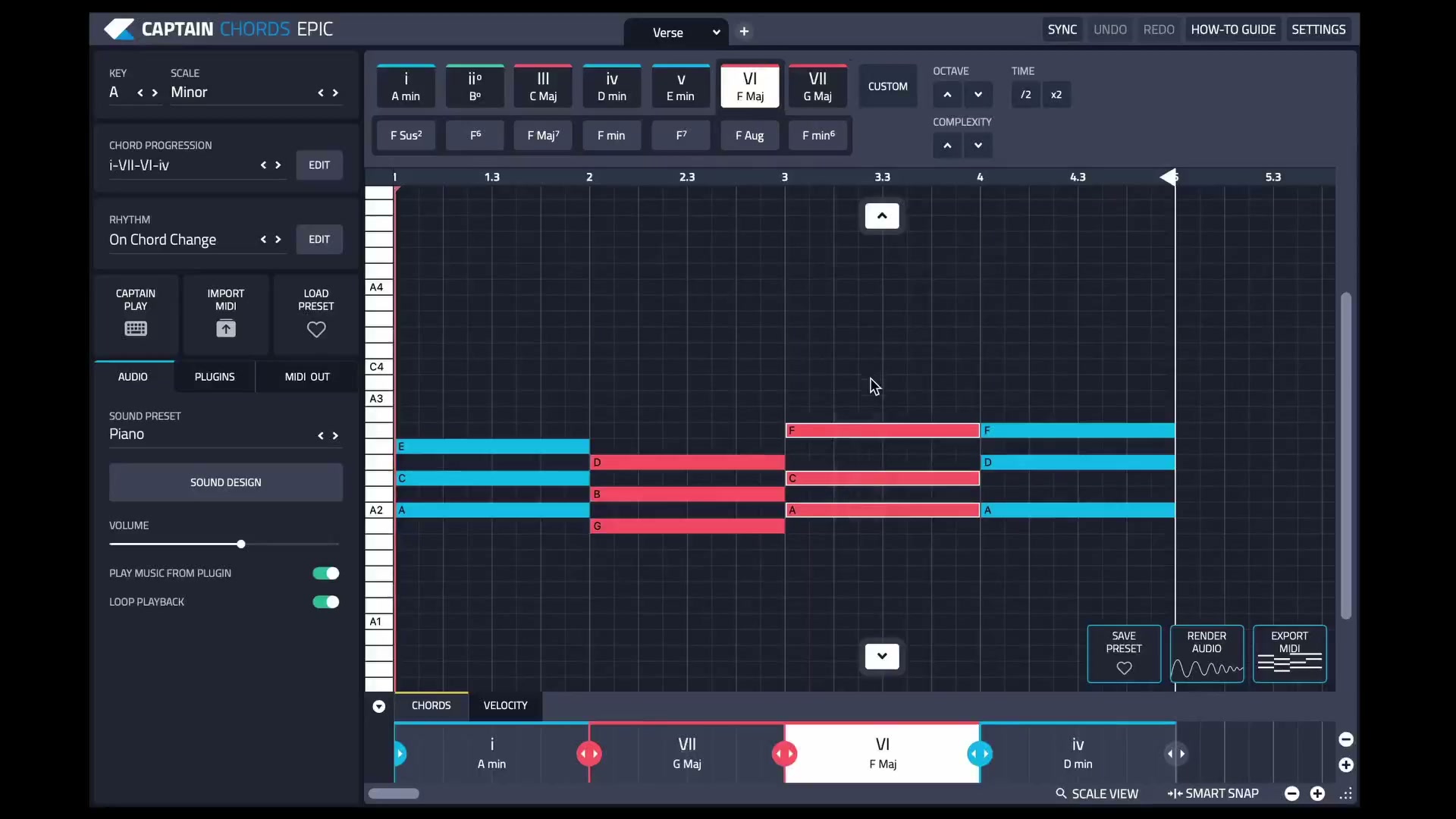
Start with C–F and insert Caug between them. Keep C as a common tone where practical and listen to the rising fifth. Export MIDI if you want to refine the line with another instrument.
See the current editing workflow.
The Captain Plugins 8 update video shows the canvas and selection-based editing.
Common questions
Does C+ mean C major?
No. C+ means C augmented. A plain C symbol means a C major triad.
Are augmented chords only for minor keys?
No. They can be used chromatically in major or minor contexts. Choose them for their voice leading and relationship to the melody.
Does an augmented triad contain a tritone?
No. Its adjacent chord tones are major thirds apart. Do not confuse an augmented fifth with a diminished fifth, which spans a tritone.
Lesson and examples updated by Mixed In Key.