


How to Use Energy Level Detection
Use the score to compare tracks, then listen to how the intro, breakdown and drop change the feel of the mix.
How to Use Energy Level Detection
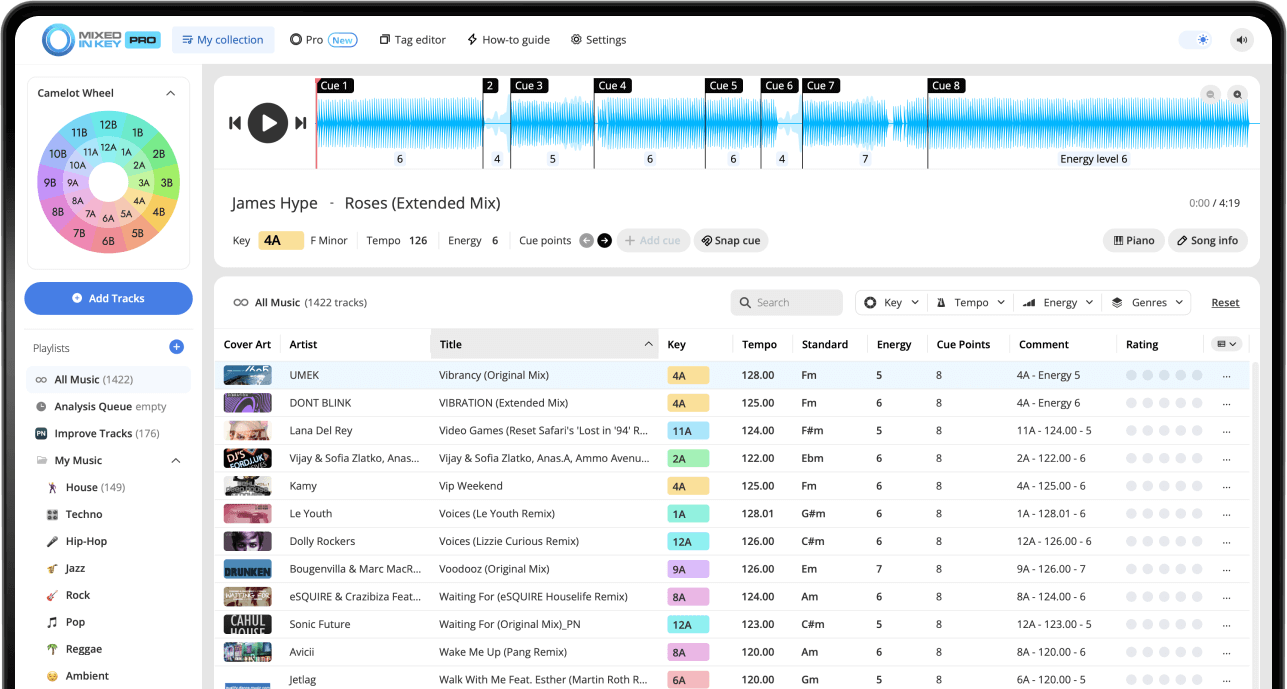
Mixed In Key 11 assigns an Energy Level that helps DJs compare tracks during library and set preparation. Use it to shortlist warmup, groove, peak-time or reset options, alongside key and BPM. Audition the intended sections: a single track-level score cannot describe every breakdown or predict the crowd’s reaction.
Key, BPM, energy and automatic Cue Points are included in Standard and Pro. Mashup suggestions, deck players, stems and key changes require Pro. Compare Standard and Pro.
What does Energy Level mean in Mixed In Key?
Energy Level is a 1 to 10 value that helps describe how intense a song feels. It gives DJs another way to understand their music beyond Key and BPM.
This is useful because two songs can have the same BPM but feel completely different. One track might feel smooth and laid-back, while another track at the same tempo might feel like a peak-time club record.
Energy Level helps you:
- Sort music by vibe and intensity
- Build warmup, groove, and peak-time playlists
- Avoid sudden energy drops
- Plan the emotional flow of a set
- Find songs that fit the time of night
Use it together with:
- Key and Camelot notation
- BPM
- Genre and mood
- Cue Points
- Your own listening test
How to think about the Energy Level scale
Mixed In Key uses a 1 to 10 Energy Level scale. Lower numbers usually feel more relaxed, while higher numbers usually feel more intense.
The exact feeling depends on the song, genre, crowd, and context, but this scale gives you a useful starting point when sorting music and building playlists.
Level 1–2
Very chill, minimal, or atmospheric. A Level 2 song may feel relaxed and may not have a strong beat.
Level 3–5
Lower to medium intensity. A Level 5 song can feel more like lounge music or a smooth groove that works earlier in the night.
Level 6–7
More danceable and upbeat. Level 6 starts to feel danceable, while Level 7 can feel upbeat for many club situations.
Level 8–10
High intensity. Level 9 and 10 tracks often feel like big club or festival moments, depending on the genre and crowd.
How Mixed In Key detects Energy Level
Energy Level is based on musical characteristics that affect how intense a song feels. One important factor is high-frequency content. Songs with more high-frequency energy, such as hi-hats, bright percussion, sharp synth stabs, and brighter production elements, often feel more energetic.
Think about the difference between a laid-back lounge track with more low and mid-frequency focus, and a club banger with bright drums, aggressive synths, and more high-frequency movement. Even if both songs are near the same BPM, the second track may feel more energetic.
Higher Energy Level can come from:
- More high-frequency content
- Brighter hi-hats and percussion
- Sharper synth sounds
- More intense arrangement
- More aggressive club or festival production
Lower Energy Level can come from:
- Smoother arrangements
- Less bright percussion
- More relaxed grooves
- Fewer intense high-frequency elements
- More laid-back mood or atmosphere
Energy Level is not the same as BPM
BPM tells you the tempo of a song. Energy Level tells you how intense the song feels. These two values are related in DJ preparation, but they are not the same thing.
A song at 120 BPM can still feel low-energy if it has a softer arrangement, fewer bright elements, or a more relaxed mood. Another song at a similar BPM can feel much more intense if it has stronger drums, brighter percussion, and a bigger arrangement.
BPM answers:
- How fast is the track?
- What tempo range does it fit?
- Can I mix it with nearby tempos?
Energy Level answers:
- How intense does the track feel?
- Does it lift or calm the set?
- Where does it belong in the night?
Use the one-level rule for smoother energy changes
A useful trick is to mix songs with the same Energy Level or songs that are only one number apart. This helps the set move naturally without a sudden drop or jump in intensity.
For example, mixing Energy Level 5 into Energy Level 5 keeps the mood steady. Mixing Energy Level 5 into Energy Level 6 creates a smooth uplifting feeling. But mixing a Level 9 banger into a Level 5 track can feel like a major drop in energy unless you are doing it intentionally.
Keep the same energy
Move from Level 5 to Level 5 when you want to maintain the same groove and keep the set steady.
Lift the set smoothly
Move from Level 5 to Level 6 when you want the next song to feel slightly more energetic.
Bring energy down carefully
Move down by one level when you want to calm the set without making the drop feel too sudden.
Avoid extreme drops
Be careful when moving from Level 9 or 10 down to Level 5. That kind of drop can make the dancefloor feel like it lost momentum.
Use Energy Level to build playlists for different parts of the night
Energy Level is a powerful way to group and separate your playlists. You can organize music by the time of night, intensity, vibe, or function inside a set.
This helps you focus on the audience and the journey you are creating, instead of spending too much time searching through a large library during preparation.
Warmup playlists
Use lower or medium Energy Level tracks when you want the room to feel relaxed, smooth, or gradually building.
Lounge or groove playlists
Use medium Energy Level tracks when you want music that feels present and musical without pushing too hard.
Peak-time playlists
Use higher Energy Level tracks for moments when the set needs to feel bigger, stronger, or more exciting.
Reset playlists
Use lower Energy Level tracks when you want to create space before building into the next section.
Use Energy Level with Key and BPM
Energy Level adds another dimension to harmonic mixing. Key tells you which songs may work together musically. BPM tells you whether the tempo movement makes sense. Energy Level tells you whether the next song fits the intensity of the moment.
When you use all three together, your playlist decisions become more intentional.
Combine Key, BPM, and Energy Level
Start with compatible Keys using the Camelot Wheel. Then check BPM to narrow your options. Finally, use Energy Level to choose the song that best supports the direction of the set.
This helps you build playlists that are harmonic, rhythmic, and emotionally controlled.

Use Cue Points to test the energy change
Cue Points help you test whether the energy change actually works. Instead of relying only on the Energy Level number, jump to the important sections of each track and listen to how the transition feels.
Use Cue Points to check intros, breakdowns, drops, and mix-out sections before deciding whether a track belongs in that part of the playlist.
Test these sections:
- Intros
- Breakdowns
- Drops
- Mix-out sections
Listen for:
- Whether the energy lift feels natural
- Whether the drop feels too sudden
- Whether the crowd moment would make sense
- Whether the next track fits the journey
Use DJ Mix Mode to find songs by Key, BPM, and Energy Level
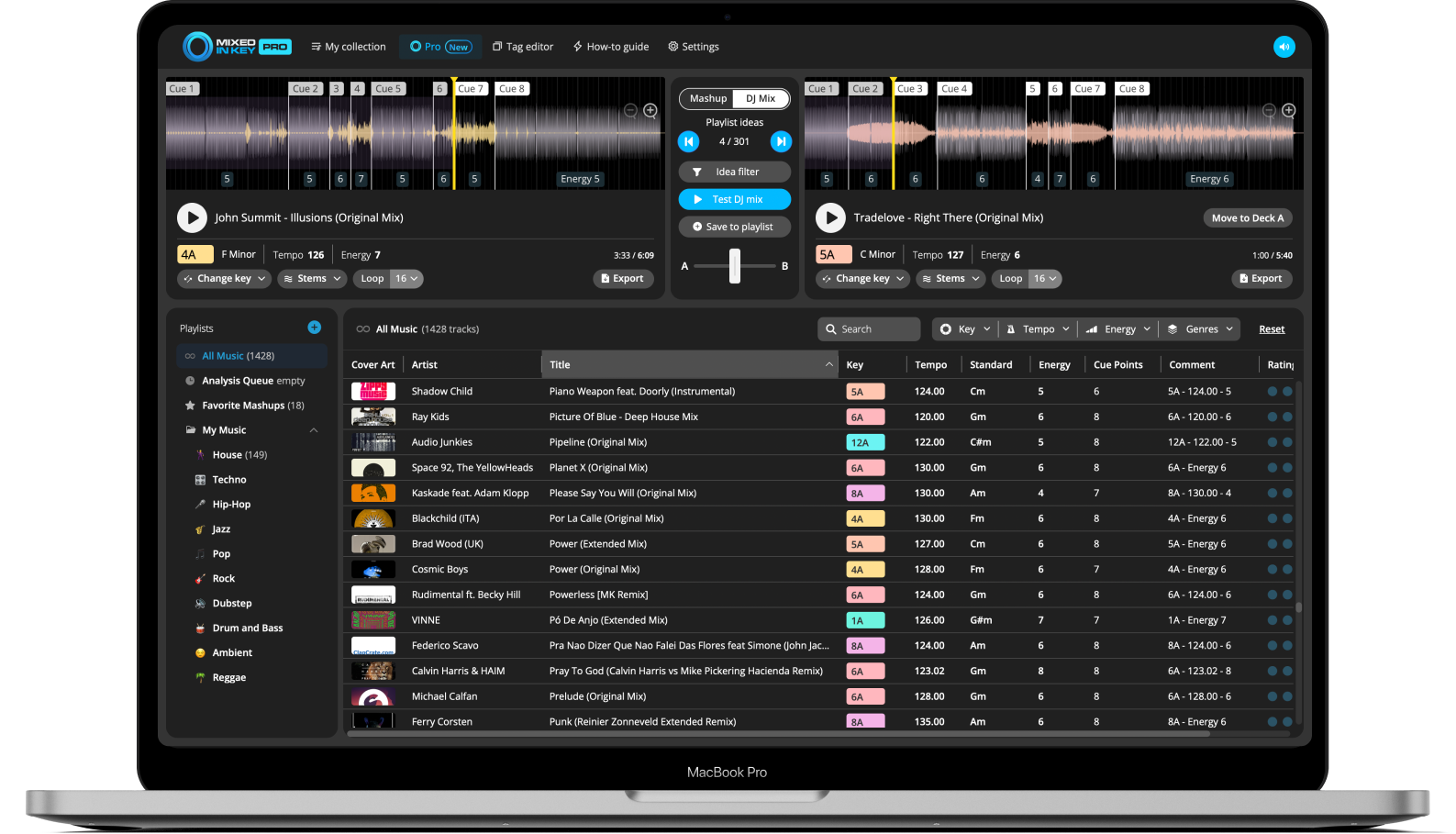
Mixed In Key Pro can help you find song combinations faster with DJ Mix Mode. This is useful when you want ideas based on Key, Energy Level, and BPM.
Instead of manually searching your entire library, DJ Mix Mode can help you discover songs that fit the energy direction of your playlist or setlist.
Find songs that fit the moment
Use DJ Mix Mode when you want to build a playlist for a warmup, peak-time section, radio show, livestream, or practice set. It can help you find songs that make sense together based on Key, Energy Level, and BPM.
Preview the combinations, save your favorites, and use your ears to make the final decision.
How to use Energy Level detection
Analyze your tracks in Mixed In Key
Add your music to Mixed In Key and let it analyze Key, BPM, Energy Level, and Cue Points.
Sort your music by Energy Level
Review the 1 to 10 Energy Level values and start grouping songs by intensity. Lower numbers can be useful for warmups and resets, while higher numbers can be useful for bigger moments.
Build playlists by vibe or time of night
Create playlists for warmup, lounge, groove, peak-time, reset, or radio show sections. Energy Level makes it easier to group tracks by how they feel.
Use the one-level rule
A one-level change can be a useful comparison to try, not a mixing rule. Listen to the actual sections and choose a bigger or smaller change when the arrangement and room call for it.
Check Key and BPM before choosing the next song
Use Key for harmonic compatibility and BPM for tempo planning. Energy Level works best when it is used together with the rest of your DJ information.
Use Cue Points to test the real transition
Jump to intros, breakdowns, drops, and mix-out sections to hear whether the energy change feels natural in the actual songs.
Use your ears and crowd knowledge
Compare the intro, breakdown and drop at the intended tempo. Familiar vocals, groove and context may matter more than a rating. Keep a track if it serves the set, even when its energy score differs from your initial shortlist.
Common mistakes when using Energy Level
Dropping from Level 9 to Level 5 too suddenly
A big drop can make the dancefloor lose momentum. Use large drops only when you want a deliberate reset or dramatic contrast.
Thinking Energy Level is the same as BPM
BPM is tempo. Energy Level is intensity. A 120 BPM track can still feel relaxed if the arrangement and frequency content are smoother.
Ignoring special crowd songs
Some songs may create a huge crowd reaction because people know every lyric. Treat those as special anchor songs and use Energy Level as part of the decision, not the whole decision.
Using Energy Level without listening
Energy Level helps you find better options faster, but you should still preview important combinations before finalizing a playlist or setlist.
Frequently asked questions
Energy Level is a 1 to 10 intensity rating that helps DJs understand how energetic a song feels. Lower numbers are usually more relaxed, while higher numbers are usually more intense.
No. BPM measures tempo, while Energy Level describes intensity. Two songs can have similar BPM values but very different Energy Levels.
A useful rule is to mix songs with the same Energy Level or songs that are one number apart. Larger jumps can work, but they should be used intentionally.
Yes. Energy Level is useful for building warmup, lounge, groove, peak-time, reset, and radio show playlists based on intensity and vibe.
Yes. Mixed In Key Pro includes DJ Mix Mode, which can help you find songs that work well together based on Key, Energy Level, and BPM.
Use Mixed In Key to organize songs by intensity and vibe.
Analyze Energy Level, Key, BPM, and Cue Points, then build playlists that match the journey you want to create for your audience.
Updated