


How to Change Energy With the Camelot Wheel
Choose the direction of the set first. Use key, energy and tempo to shortlist tracks, then test the sections that will overlap.

How to Change Energy With the Camelot Wheel
Use Camelot notation to find harmonic options and Energy Level to compare track intensity. Same-key, adjacent-number and relative-major/minor moves are useful starting points. Advanced +2 or −5 moves can add tension, but they do not guarantee a lift: the incoming track, arrangement and transition matter.
Key, BPM, energy and automatic Cue Points are included in Standard and Pro. Mashup suggestions, deck players, stems and key changes require Pro. Compare Standard and Pro.
What does “energy” mean in a DJ set?
Energy in a DJ set is not only about volume or speed. It is the overall feeling of intensity, tension, momentum, groove, and crowd response. A track can feel high-energy because of its drums, bassline, arrangement, drop, vocal impact, or harmonic tension.
Mixed In Key helps you manage energy by showing each track’s Energy Level. When you combine that with Camelot Key and BPM, you can make better decisions about where a track belongs in the set.
You can use energy to:
- Build momentum
- Maintain a groove
- Create contrast
- Reset the room
- Prepare a stronger peak moment
Energy is affected by:
- Energy Level
- BPM
- Key movement
- Track arrangement
- Where you mix in and out
Use Camelot movement to control musical direction
The Camelot Wheel helps DJs find musical Keys that are related to each other. Mixed In Key shows each track with a Camelot notation, such as 8A or 9B. A means minor, and B means major.
Regular Camelot movement is useful when you want a set to feel smooth and connected. More dramatic Camelot moves can create extra excitement, but they should be used with intention.
Start with the common Camelot moves
The most common harmonic moves are staying in the same Camelot notation, moving one number up, moving one number down, or switching between A and B on the same number.
These moves are strong starting points when you want a mix that feels connected, musical, and less likely to clash.
Smooth movement
From 8A, try 8A, 7A, 9A, or 8B. These are the most common starting points for smooth harmonic mixing.
More energetic movement
From 8A, a move to 10A can create an Energy Boost. This is a stronger harmonic move and works best when used intentionally.
Use Energy Level with the Camelot Wheel
Camelot Key tells you which songs may work together harmonically. Energy Level tells you how intense each track feels. To change energy well, use both pieces of information together.
A compatible Key does not automatically mean the energy will feel right. A low-energy song and a high-energy song can be harmonically compatible, but the jump may still feel too sudden unless that is what you want.
Lift the set
Choose a harmonically compatible song with a higher Energy Level when you want the next track to feel bigger or more exciting.
Hold the groove
Choose a compatible song with a similar Energy Level when you want the set to stay steady and controlled.
Reset the mood
Choose a compatible song with a lower Energy Level when you want to create space before building again.
Create contrast
Choose a different Energy Level when you want the next song to feel like a deliberate change in direction.
Use Energy Boost mixing for a stronger lift
Energy Boost mixing is an advanced harmonic mixing technique where you move +2 numbers on the Camelot Wheel. It is designed to create a quick burst of excitement in the set.
For example, if your current track is 8A, an Energy Boost move would be 8A to 10A. If your current track is 5A, an Energy Boost move would be 5A to 7A.
Energy Boost examples
- 5A → 7A
- 8A → 10A
- 7B → 9B
- 10B → 12B
When to use it
- When you want a noticeable lift
- When the crowd needs a burst of excitement
- When the next section should feel bigger
- When the Energy Level also supports the move
Another advanced boost: the -5 Camelot move
Another advanced energy technique is moving -5 numbers on the Camelot Wheel. For example, if your current track is 8A, a -5 move would take you to 3A.
This can create a strong energy change, especially when combined with an increase in Energy Level. Because it is more dramatic than the basic Camelot moves, it should be tested carefully before using it in a set.
Example -5 moves
- 8A → 3A
- 12A → 7A
- 9B → 4B
- 6B → 1B
Use carefully
This move can add excitement, but it is not the same as a simple smooth transition. Check the Energy Level, arrangement, and actual sound of the mix before relying on it.
Other ways to change energy with harmonic mixing
Energy Boost is not the only way to change the energy of a DJ set. You can also change energy more gradually with standard Camelot moves, Energy Level changes, BPM movement, and mood shifts between minor and major Keys.
Move gradually around the wheel
Use -1, 0, or +1 Camelot movement when you want the set to stay smooth while still moving forward.
Switch between A and B
Moving between the same number on A and B can shift the mood between relative minor and major Keys while staying closely related.
Increase Energy Level
Choose a compatible song with a higher Energy Level when you want the next track to feel more intense.
Use BPM carefully
A slightly higher BPM can help the set feel more energetic, but large tempo jumps should be planned carefully.
Use Cue Points to test the energy change
Cue Points help you test energy changes faster. Instead of listening through the entire track, you can jump to the parts that matter most when deciding whether a transition creates the right lift, hold, reset, or contrast.
Use Cue Points to check intros, breakdowns, drops, and mix-out sections before deciding where the next song belongs in the set.
Test these sections:
- Intros
- Breakdowns
- Drops
- Mix-out sections
Listen for:
- Whether the lift feels natural
- Whether the energy jump feels too sudden
- Whether the transition section is too busy
- Whether the next track fits the moment
Use DJ Mix Mode to find energy-friendly song ideas
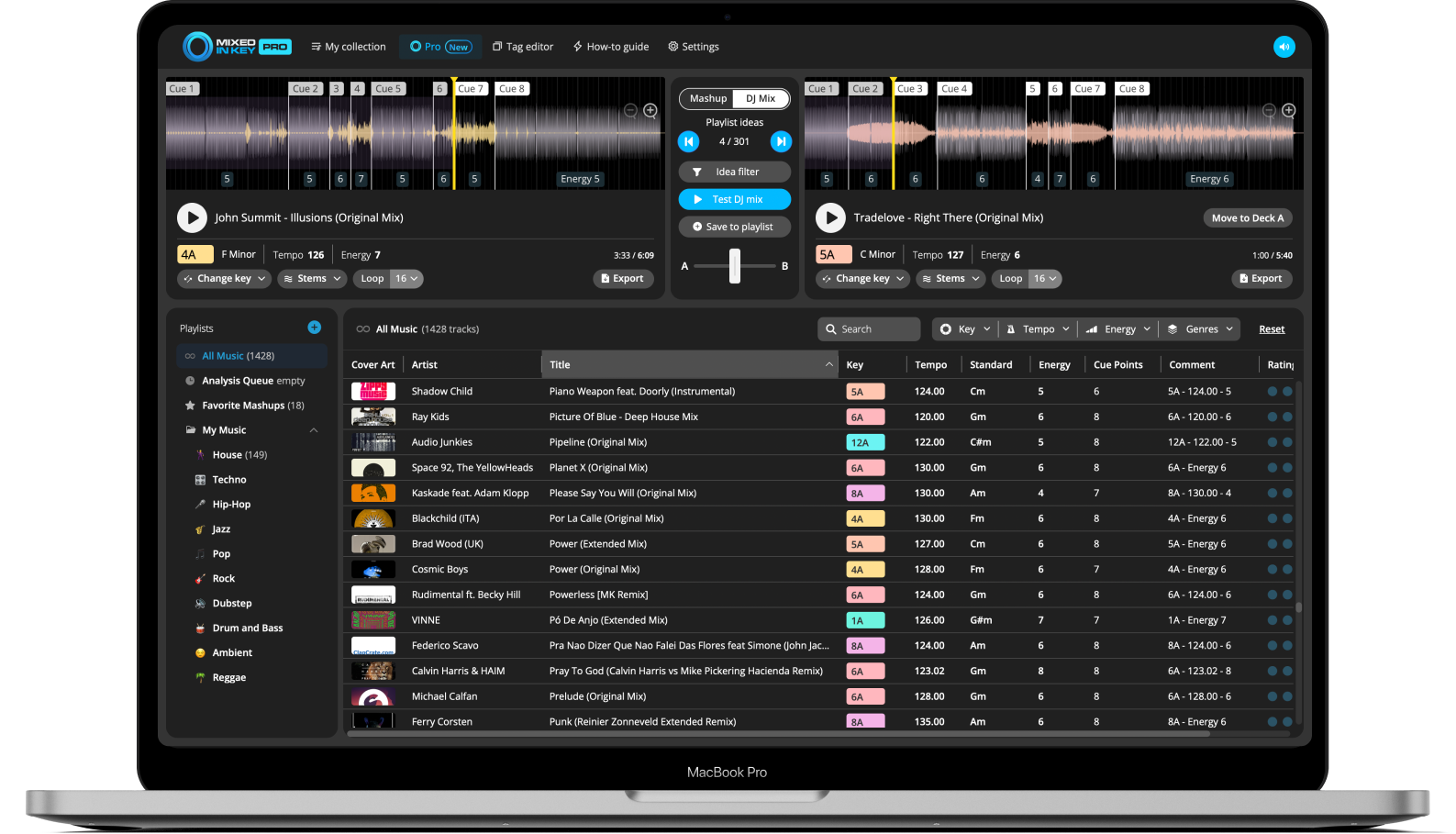
Mixed In Key Pro can help you find songs that could work well together with DJ Mix Mode. This is useful when you want playlist ideas based on Key, Energy Level, and BPM.
Use DJ Mix Mode when you want to build a set that changes energy intentionally instead of manually searching your entire library for possible next tracks.
Find songs that support the energy direction
DJ Mix Mode helps you discover combinations that make sense for the direction of your set. You can look for songs that lift the energy, hold the groove, or create a different mood.
Once you find promising combinations, preview them and save your favorites as you build the playlist or setlist.
How to change energy with the Camelot Wheel
Analyze your tracks in Mixed In Key
Start by analyzing your music so you can see Key, BPM, Energy Level, and Cue Points before building your set or testing transitions.
Check the Camelot Key of your current track
Look at the Camelot notation of the song you are mixing from. For example, your current track might be 8A, which means A minor.
Decide what kind of energy change you want
Decide whether the next song should lift the set, hold the groove, reset the mood, or create contrast. This decision should guide the Key, Energy Level, and BPM you choose next.
Choose a Camelot move
Start with the same notation, one number either way, or the matching A/B position. For an advanced option, try +2 while keeping the letter, such as 8A to 10A. These keys are not as closely related as adjacent moves; audition the exact overlap and shorten it if the melodic parts clash.
Compare Energy Level and BPM
Check whether the Energy Level supports the move you want. Then compare BPM to make sure the tempo change makes sense for the set.
Use Cue Points to test the transition
Jump to intros, breakdowns, drops, and mix-out sections so you can hear whether the energy change feels natural or too sudden.
Preview and refine the set
Use the Camelot Wheel and Energy Level as guides, then listen to the actual combination. If the energy change feels right, save it. If it feels forced, try a smoother Camelot move or a different Energy Level.
Common mistakes when changing energy
Overusing Energy Boost mixing
A +2 move may add tension, but the key number does not predict the crowd response. Compare the actual sections, energy and phrasing. Keep a smoother alternative ready and use the advanced move only when the musical result supports the set.
Ignoring Energy Level
A Camelot move can be harmonically useful, but the Energy Level still needs to fit the moment in the set.
Jumping too far in BPM
BPM changes can add excitement, but large jumps should be planned carefully so the set does not feel rushed or disconnected.
Mixing during busy sections
Even a good Key and Energy Level match can feel messy if both tracks have busy melodic parts playing at the same time.
Frequently asked questions
Energy Boost mixing is an advanced harmonic mixing technique where you move +2 numbers on the Camelot Wheel. For example, 8A to 10A can create a noticeable lift in the set.
No. Energy Boost mixing works best in moderation. It creates a stronger lift, so using it too often can make the set feel forced or overwhelming.
No. Camelot Key helps with harmonic compatibility. Energy Level helps describe how intense a track feels. Both are useful when deciding what to play next.
Yes. To lower or reset energy, choose a harmonically compatible song with a lower Energy Level, a smoother arrangement, or a more relaxed section. The Camelot Wheel helps you keep the move musical while Energy Level helps you control intensity.
Mixed In Key Pro includes DJ Mix Mode, which helps you find songs that could work well together based on Key, Energy Level, and BPM. This can make it easier to build playlists with intentional energy changes.
Use Mixed In Key to plan smoother lifts, resets, and peak moments.
Analyze Key, BPM, Energy Level, and Cue Points, then use the Camelot Wheel and DJ Mix Mode to find songs that support the direction of your set.
Updated