


In this article
Start a bassline with the chord roots and a rhythm that fits the drums. Then adjust note lengths, try useful chord tones and add passing notes where they lead clearly into the next harmony.
Map the chord roots
For Am–F–C–G, begin with A–F–C–G in a suitable bass register. Keep the first version simple enough to hear every chord change. A bass note supplies both pitch and rhythm, so its position can alter how strongly the harmony arrives.
Find a rhythm with the kick
Play the kick and bass together before adding the rest of the arrangement. Try a note on the downbeat, then a note between kick hits. There is no requirement to follow every kick; choose a pattern that makes the combined groove clear.
Set note lengths for the sound
A sustained sub, plucked bass and sampled 808 respond differently to the same MIDI pattern. Listen to the release and any glide behavior. Shorten overlaps that blur changes, or keep them when the legato movement is intentional.
Add a small amount of harmonic movement
A third or fifth can provide a different inversion, while a passing note can connect roots. Add one change at a time and return to the simple version for comparison. Check longer or strongly accented notes especially carefully because they carry more harmonic weight.
Write a phrase-ending variation
Keep most of the loop stable and add a fill before the repeat or next section. An octave, a shorter note or a brief rest may be enough. Make sure the fill leaves a clear entry for the next downbeat.
Hear root notes and root–fifth movement
The chord sequence stays C–Am–F–G. The second bass line uses each chord’s root and fifth while preserving the same harmony.
A · Follow the roots
One low root supports each bar.
C2–A1–F2–G2.
Ready to play
Original synthesized lesson examples with a simple piano-like tone. These illustrate the musical idea; they are not recordings of Captain Plugins or finished genre productions.
Try this in your project
Write an eight-bar bassline over Am–F–C–G. Use only roots for the first four bars. In the second four, add one octave and one passing note, then compare both with the same drum pattern.
Quick reference
| Focus | What to try | What to listen for |
|---|---|---|
| Roots | Map the chord changes | A clear harmonic foundation |
| Groove | Test timing against the kick | A combined rhythm that works |
| Movement | Add one passing note or inversion | Direction without crowding the low end |
Work with Captain Deep
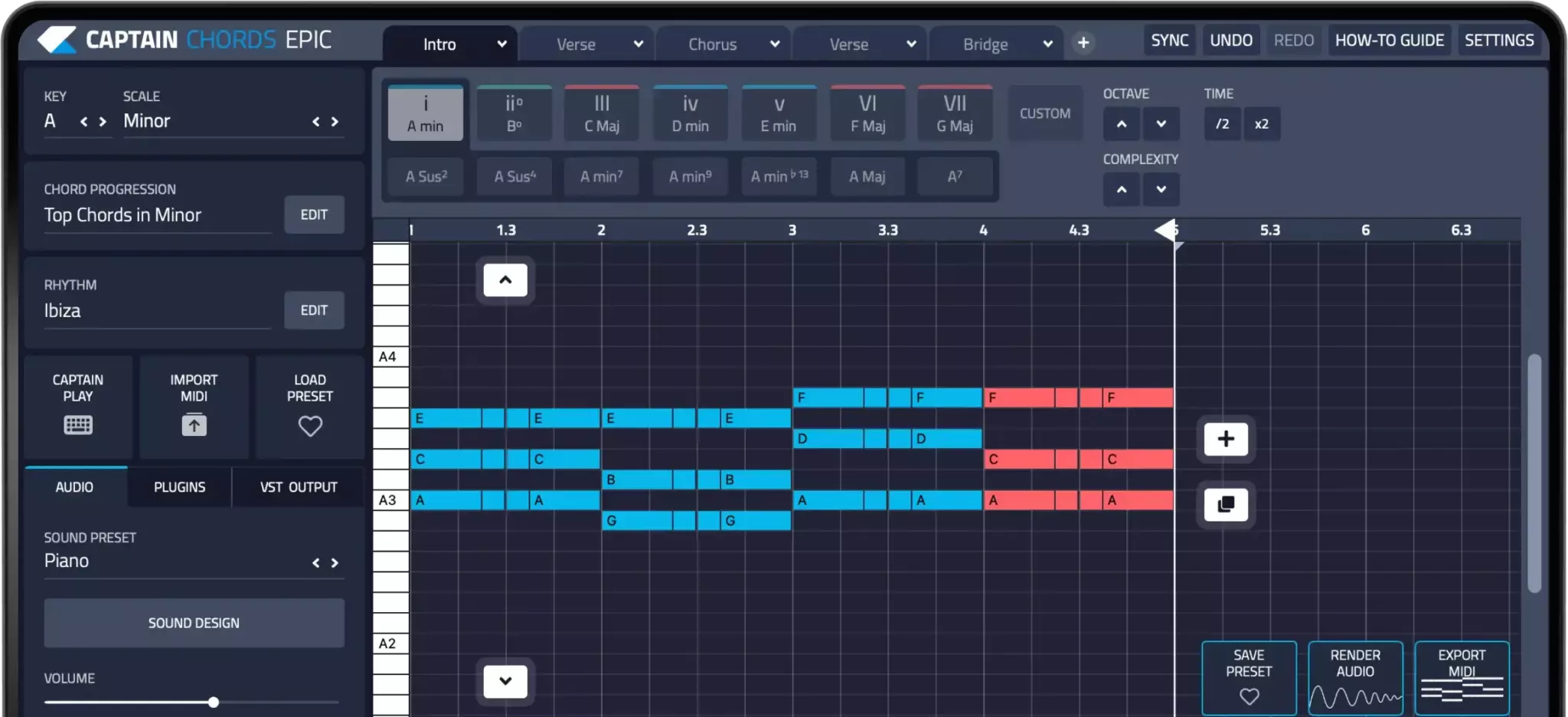
Use Captain Deep to write a bass part alongside your Captain Chords progression. Check the note lengths and rhythm against the drums.
Captain Plugins 8 overview
See the update video for the current canvas and editing workflow.
Create a bassline from chords in Wingman
Common questions
Can I write bass before chords?
Yes. A bass riff can suggest the harmony. Try chords that support its emphasized notes and rhythm.
Can Captain Deep help with the chord relationship?
Captain Deep can connect to Captain Chords and provide a bass-writing workflow around the progression. Use the linked guide for its connection and editing controls.