


In this article
F natural minor contains F, G, A-flat, B-flat, C, D-flat and E-flat. Its diatonic triads are Fm, G diminished, A-flat, B-flat minor, Cm, D-flat and E-flat. Raising E-flat to E gives the leading tone used in F harmonic minor.
Separate the chord from the key
The F minor chord contains F, A-flat and C. The key of F minor includes a broader set of melodic and harmonic relationships centered on F. Begin by hearing Fm as a point of arrival, then add chords that move away from and back toward it.
Build chords from natural minor
Stack alternate notes of the scale to produce Fm, G diminished, A-flat, B-flat minor, Cm, D-flat and E-flat. In scale-degree terms these are i, ii diminished, III, iv, v, VI and VII. The minor v chord, Cm, contains C–E-flat–G.
Try a natural-minor loop
Play Fm–D-flat–A-flat–E-flat, one chord per bar. It uses i–VI–III–VII and can repeat smoothly without a major dominant. Change the bass rhythm and upper-note voicing before adding more chords; those choices can change the feel while the harmonic sequence stays the same.
Hear the major dominant
Replace Cm with C major or C7 when you want a stronger pull toward Fm. C7 contains C–E–G–B-flat. E natural sits a semitone below F and can resolve upward into it. This note is outside F natural minor but is common in tonal minor-key harmony.
Distinguish F minor from A-flat major
F minor and A-flat major share a four-flat key signature. A sequence of the same chords can suggest either tonal center depending on emphasis, order and melody. Listen for where the phrase settles rather than identifying the key from the available notes alone.
Hear the minor and major dominant
Both examples start Fm–B♭m. Compare Cm, from F natural minor, with C7, which raises E-flat to E natural before Fm returns.
A · Fm–B♭m–Cm–Fm
The minor dominant uses E-flat. All notes belong to F natural minor.
F–A♭–C | B♭–D♭–F | C–E♭–G | F–A♭–C.
Ready to play
Original synthesized lesson examples with a simple piano-like tone. These illustrate the musical idea; they are not recordings of Captain Plugins or finished genre productions.
Try this in your project
Compare Fm–B-flat minor–Cm–Fm with Fm–B-flat minor–C7–Fm. Keep rhythm and voicing as similar as possible. Listen specifically to E-flat versus E natural in the dominant chord and the return to F.
Quick reference
| Focus | What to try | What to listen for |
|---|---|---|
| Tonic | Fm: F–A-flat–C | The minor-key center |
| Natural-minor dominant | Cm: C–E-flat–G | A softer return without a leading tone |
| Major dominant | C7: C–E–G–B-flat | E natural leading into F |
Work with Captain Chords
Use Captain Chords to sketch the harmony, edit its voicing and rhythm, then develop the arrangement in your DAW.
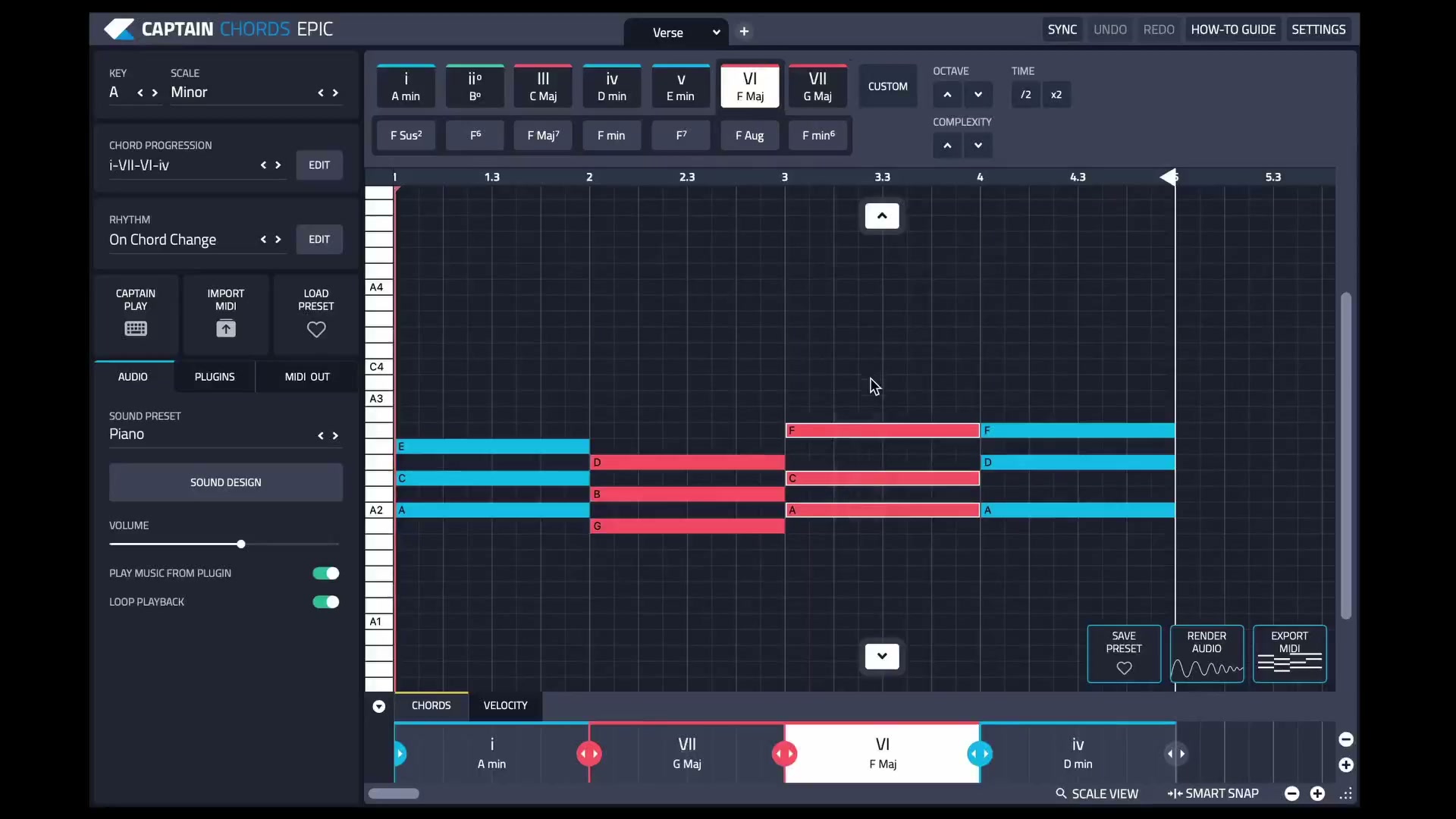
Captain Plugins 8 overview
See the update video for the current canvas and editing workflow.
Common questions
Why does C major appear in F minor?
Its E natural acts as a leading tone to F. Minor-key harmony often uses this raised seventh degree rather than staying entirely within natural minor.
Is F minor the same as A-flat major?
They share a key signature, but their tonal centers and chord functions differ.