


How to Plan a DJ Set With Harmonic Mixing
Plan a few useful routes through your crate. Check the transitions and keep alternatives for a change in the room.
How to Plan a DJ Set With Harmonic Mixing
Decide the purpose of the set, analyze your tracks in Mixed In Key 11 and shortlist harmonic options in the right tempo and energy range. Rehearse the actual mix-in and mix-out sections, then keep backup tracks. Standard provides the analysis; Pro’s DJ Mix Mode offers further combinations to audition. A set plan should support your choices at the gig, not lock you into one order.
Key, BPM, energy and automatic Cue Points are included in Standard and Pro. Mashup suggestions, deck players, stems and key changes require Pro. Compare Standard and Pro.
Why plan your DJ set harmonically?
Harmonic mixing helps you choose songs that can sound natural together. Instead of guessing which tracks might fit, you can use Camelot Key information to find songs that are likely to be musically compatible.
This does not mean every song in your set has to stay in the same Key. It means you can move through compatible Keys in a way that supports the emotional direction of the set.
Harmonic planning helps you:
- Avoid clashing Keys
- Find smoother transition options
- Build more musical playlists
- Create a sense of flow across the set
- Prepare faster before a gig or recording
A strong set also needs:
- BPM control
- Energy Level control
- Phrase awareness
- Track structure knowledge
- Crowd awareness and taste
Decide what kind of set you are planning
Before choosing tracks, decide what the set is supposed to do. A warmup set, peak-time club set, radio show, livestream, opening set, and after-hours set should not all have the same shape.
The purpose of the set helps you decide how fast to build, how much energy to use, how adventurous the Key movement should be, and how many backup options you need.
Ask yourself:
- What time of night is this set?
- Is this a warmup, headline, or closing set?
- How long is the set?
- What kind of crowd or venue is it for?
- Should the set build slowly or move quickly?
Then decide:
- Starting Energy Level
- Target peak Energy Level
- Main BPM range
- Starting Camelot Key area
- How much room to leave for flexibility
Analyze your music before planning the set
Start by analyzing your tracks in Mixed In Key. This gives you the information you need to plan a harmonic set instead of guessing.
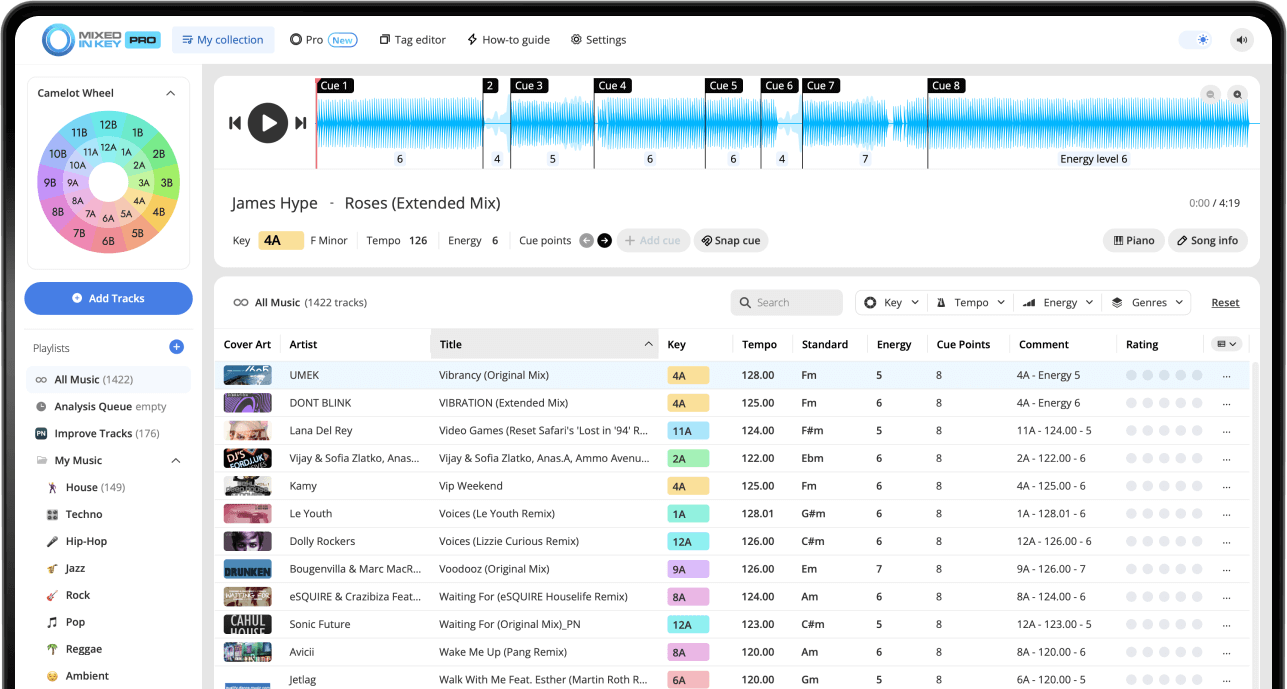
Mixed In Key helps you see Key, BPM, Energy Level, and Cue Points. These four pieces of information are the foundation for planning a set that feels musical and practical.
Use Key to:
Find songs that may work together harmonically and avoid clashing Keys.
Use BPM to:
Keep the tempo movement realistic for the type of set you are planning.
Use Energy Level to:
Decide when the set should lift, hold, reset, or peak.
Use Cue Points to:
Test intros, breakdowns, drops, and mix-out sections before finalizing the order.
Use the Camelot Wheel to plan harmonic movement
The Camelot Wheel gives you a simple way to choose compatible Keys. Each Key has a number and a letter. A means minor, and B means major.
For basic harmonic movement, stay in the same Camelot Key, move one number up, move one number down, or switch between A and B on the same number.
Start with safe harmonic moves
If your current song is 8A, start by looking for songs in 8A, 7A, 9A, and 8B. These are strong starting points when planning a smooth harmonic section.
After you build confidence, you can test more advanced Camelot movement, but basic compatible Keys are the best foundation for set planning.

Plan the BPM flow of the set
A harmonic set still needs practical tempo movement. BPM helps you decide whether your planned songs can sit together naturally or whether the set needs a different order.
You can keep the set in one BPM range, build gradually, or use planned tempo changes for contrast. The right choice depends on the type of set, the venue, and the crowd.
For a smoother set
Keep BPM movement gradual and avoid unnecessary tempo jumps unless you have a reason for them.
For an open-format set
Use BPM groups to plan where tempo changes happen, then use Key and Energy Level to make those changes feel intentional.
For a recorded mix
Plan the BPM curve in advance so the set feels controlled from beginning to end.
For a live gig
Prepare backup options at nearby BPM ranges so you can adapt if the room changes direction.
Plan the Energy Level journey
Energy Level helps you plan how intense the set should feel over time. This is important because a harmonic transition can still feel wrong if the energy change is too sudden.
A useful rule is to move by one Energy Level when you want a smooth build. For example, Energy Level 5 into Energy Level 6 can create a natural lift. Bigger changes can work, but they should feel intentional.
Warmup section
Use lower or medium Energy Level tracks to create atmosphere without rushing the room.
Build section
Increase Energy Level gradually while keeping Key and BPM movement controlled.
Peak section
Use higher Energy Level tracks when the set needs more impact.
Reset section
Bring Energy Level down carefully when you want to create space before building again.
Think about phrasing and track structure
Harmonic mixing helps songs sound musically compatible, but phrasing helps the transition feel natural. Even if two songs are in compatible Keys, the mix can feel awkward if the wrong sections overlap.
Listen for phrase changes, breakdowns, drops, and mix-out sections. A good set plan should respect how each track is built.
Good moments to test
- Intro over outro
- After a chorus or main section
- Coming out of a breakdown
- Before a new phrase begins
- At the start of a mix-out section
Be careful with:
- Two busy melodic sections at once
- Breakdown into breakdown
- High-intensity section into a weak intro
- Big Energy Level drops by accident
- Long blends between incompatible elements
Use Cue Points to test the set plan
Cue Points help you move from theory to reality. Once you have a harmonic set order, use Cue Points to test whether the transitions actually work.
Use Cue Points to jump to intros, breakdowns, drops, and mix-out sections. Then listen to how the Key, BPM, Energy Level, and arrangement work together.
Use Cue Points to confirm:
- The intro works over the outgoing song
- The breakdown does not kill the energy too early
- The drop lands at the right moment
- The mix-out section gives you enough time
- The planned transition feels natural
Use your ears to check:
- Whether the Keys feel compatible
- Whether the energy lift feels smooth
- Whether the BPM movement feels comfortable
- Whether the phrasing is clean
- Whether the set still feels exciting
Use DJ Mix Mode to find set ideas faster
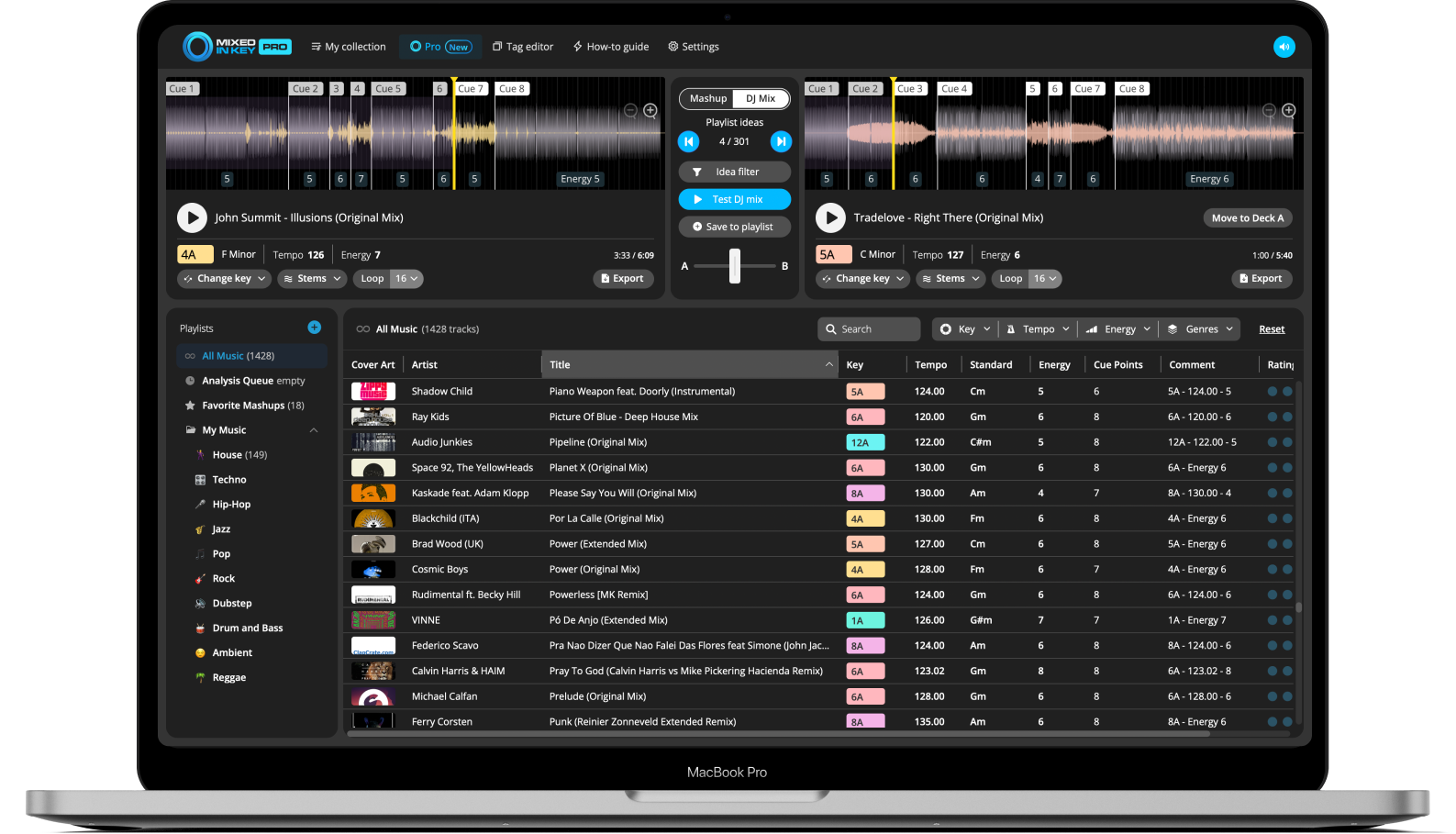
Mixed In Key Pro can help you plan a DJ set faster with DJ Mix Mode. It helps you find songs that could work well together based on Key, Energy Level, and BPM.
This is useful when you have a starting track and want to find possible next songs, build a harmonic section, or discover playlist ideas from your own library.
Find harmonic set options
Use DJ Mix Mode to find songs that support the direction of your set. You can look for options that hold the same energy, lift the room, create contrast, or continue a harmonic path.
Preview the combinations, save favorites, and use them as building blocks for your final setlist.
How to plan a DJ set with harmonic mixing
Decide the purpose of the set
Choose whether you are planning a warmup set, peak-time set, closing set, radio show, livestream, practice set, or specific gig playlist.
Analyze your music in Mixed In Key
Analyze your tracks so you can see Key, BPM, Energy Level, and Cue Points before building the set.
Choose a starting track
Pick a starting track that fits the moment. Check its Camelot Key, BPM, and Energy Level.
Find compatible Camelot Keys
Look for songs in the same Camelot Key, one number up, one number down, or the matching A/B position.
Filter by BPM
Narrow your harmonic options to songs that make sense for the tempo range of the set.
Shape the Energy Level
Arrange songs so the energy builds, holds, resets, or peaks intentionally.
Use Cue Points to test transitions
Jump to intros, breakdowns, drops, and mix-out sections to confirm that the planned order works in practice.
Use DJ Mix Mode for more ideas
In Mixed In Key Pro, use DJ Mix Mode to find additional set ideas based on Key, Energy Level, and BPM.
Save backup options
Keep alternatives for each part of the set: a different energy level, a shorter transition or a tempo change. Include tracks you know well so you can respond to the room without searching the whole library.
Listen through the set plan
Preview the key transitions and energy changes before the gig or recording. Adjust anything that feels forced.
Example harmonic set structures
These are starting points. The best structure depends on the room, genre, crowd, and how much flexibility you want during the set.
Smooth harmonic build
Start in one Camelot area and move gradually around the wheel while Energy Level rises one step at a time.
Example: 7A → 8A → 9A → 9B
Warmup into groove
Start with lower Energy Level tracks, keep BPM controlled, and use harmonic movement to make the set feel polished without pushing too hard.
Peak-time harmonic section
Use compatible Keys and higher Energy Level tracks to keep the room moving while avoiding clashing melodic sections.
Reset and rebuild
Bring Energy Level down carefully, choose a compatible Key, then build again with a new mood or direction.
Common mistakes when planning harmonic DJ sets
Planning only by Key
Key matters, but BPM, Energy Level, arrangement, and crowd reaction matter too.
Ignoring Energy Level
Compatible Keys can still feel wrong if the next song drops or jumps in intensity too suddenly.
Forcing long blends
If a harmonic move is more adventurous, keep the blend shorter and test it before using it in a set.
Mixing busy sections together
Two compatible songs can still clash if both sections are too melodically dense.
Not preparing backup songs
A live set needs flexibility. Prepare extra tracks in nearby Keys and Energy Levels.
Ignoring the room
Use the plan as preparation. If the crowd or time slot calls for another direction, change the order or transition method. Key and energy values describe musical options; they do not predict which track the room will want.
Frequently asked questions
Harmonic set planning means arranging a DJ set with Key compatibility in mind. Instead of choosing songs only by genre or BPM, you use Camelot Key information to plan smoother musical movement.
No. You can stay in the same Key, move one number up or down on the Camelot Wheel, or switch between A and B on the same number. The goal is compatible movement, not staying in one Key all night.
For recorded mixes and radio shows, a full plan can be useful. For live gigs, it is better to prepare sections, backup options, and possible paths so you can adapt to the crowd.
Energy Level helps you decide where each harmonic option belongs in the set. It can help you build gradually, hold the groove, create a reset, or plan a peak-time section.
Yes. Mixed In Key Pro includes DJ Mix Mode, which can help you find songs that work well together based on Key, Energy Level, and BPM. This is useful for planning set sections and finding next-song ideas.
Use Mixed In Key to build smoother harmonic setlists.
Analyze Key, BPM, Energy Level, and Cue Points, then use Mixed In Key Pro DJ Mix Mode to find song combinations that fit your set.
Updated